Fannie, Freddie Capital Concerns Prompt Paulson Plan
http://www.bloomberg.com/apps/news?pid=20601087&sid=aMX336c2lWGQ&refer=worldwide
By Dawn Kopecki and Alison Vekshin
Sept. 7 (Bloomberg) -- Treasury Secretary Henry Paulson decided to take control of Fannie Mae and Freddie Mac after a review found the beleaguered mortgage-finance companies used accounting methods that inflated their capital, according to people with knowledge of the decision.
Paulson will hold a press conference at 11 a.m. today in Washington, according to a statement. Morgan Stanley, hired by the Treasury to probe the companies' finances, concluded the accounting, while legal, enabled Freddie, and to a lesser extent Fannie, to overstate the value of their reserves, according to the people who declined to be identified because the findings are confidential.
The Treasury plans to put Fannie and Freddie into a so- called conservatorship and pump capital into the companies, House Financial Services Committee Chairman Barney Frank said in an interview yesterday. The government would make periodic capital injections by buying convertible preferred shares or warrants, according to a person briefed on the plan. Paulson is seeking to end a crisis of confidence in the companies sparked by concern the companies didn't have enough capital to weather the biggest housing slump since the Great Depression.
The Treasury was ``convinced that the markets simply wouldn't respond until after something like this,'' said Frank, who was brief by Paulson. ``I think it's an important combination.''
Debt Holders Protected
Paulson gathered Federal Reserve Chairman Ben S. Bernanke, Federal Housing Finance Agency Director James Lockhart, Fannie Chief Executive Officer Daniel Mudd and Freddie CEO Richard Syron to discuss the plan to take control of the government- sponsored enterprises, which have operated as private shareholder-owned corporations for almost 40 years. Lockhart will also speak at today's press conference, the statement said.
Holders of the companies' common and preferred stock are ``very unlikely to come out of this at all happy,'' and the chief executive officers will be forced out, Frank said. Senior and subordinated debt holders will likely be protected, said other people who were briefed on the plan.
Fannie and Freddie own or guarantee almost half of the $12 trillion in U.S. home loans and the government had been leaning on the companies to help pull the economy out of the housing crisis. Instead, they got caught in the same slump that left the world's banks with more than $500 billion of losses since the collapse of the subprime-mortgage market last year.
Rising Costs
Concern over the companies' capital pushed their borrowing costs to record levels over U.S. Treasuries, sent their common and preferred stocks tumbling and boosted mortgage rates. Washington-based Fannie is down about 66 percent in New York Stock Exchange trading since the end of June. McLean, Virginia- based Freddie has fallen about 69 percent.
Paulson met with Mudd, 50, and Syron, 64, Sept. 5 to tell them of the decision to remove the executives from their jobs, according to two people briefed on the discussions. Mudd, who replaced three top executives almost two weeks ago, is negotiating with regulators to stay on in a consultative role for several months, according to people with knowledge of the talks.
A government takeover would be the latest attempt to blunt the impact of the yearlong credit crisis, after the Fed provided financing for Bear Stearns Cos.'s takeover by JPMorgan Chase & Co.
``They have to open their wallet,'' Bill Gross, manager of the world's biggest bond fund at Newport Beach, California-based Pacific Investment Management Co. About 61 percent of Gross's holdings were mortgage-backed securities as of June 30, mostly debt guaranteed by Fannie, Freddie or government agency Ginnie Mae, according to data on Pimco's Web site.
Obama, McCain Briefed
Pimco and other large investors may put in their own money once the Treasury decides to inject government funds, Gross said Sept. 5 in a Bloomberg Television interview.
Paulson hired Morgan Stanley a month ago to advise on Fannie and Freddie. Mark Lake, a spokesman for Morgan Stanley, declined to comment. Paulson also consulted with Bank of America Corp. Chief Executive Officer Kenneth Lewis on his plan, according to people with knowledge of the talks. Bank of America spokesman Scott Silvestri declined to comment.
The Treasury briefed Democratic presidential candidate Barack Obama yesterday and has contacted Republican contender John McCain's staff. Officials also discussed the plans with House Speaker Nancy Pelosi, Senate Majority Leader Harry Reid and Senate Banking Committee Chairman Christopher Dodd.
``We are making progress on our work with Morgan Stanley, FHFA and the Fed,'' Treasury spokeswoman Brookly Mclaughlin said Sept. 5 in Washington, declining to comment on any specific plans. FHFA spokeswoman Stefanie Mullin declined to comment.
Losses Grow
Fannie was created by the government in 1938 as part of President Franklin D. Roosevelt's New Deal. Freddie was chartered in 1970 to compete with Fannie.
As losses on the mortgages grew late last year, the companies recorded $14.9 billion in combined net losses, eating into their capital. Fannie raised $14.4 billion since November and Freddie sold $6 billion of preferred securities. Plans for a $5.5 billion sale were delayed as the company's fortunes sank.
Fannie had $47 billion of capital as of June 30, according to company filings. The company is required by its regulator to hold $37.5 billion. Freddie's capital stood at $37.1 billion, compared with a requirement of $34.5 billion, filings show.
Critics including former Federal Reserve Chairman Alan Greenspan and Richmond Federal Reserve Bank President Jeffrey Lacker have called for the companies to be nationalized. William Poole, the former head of the St. Louis Fed said in July that Freddie Mac is technically insolvent and Fannie Mae's fair value may be negative next quarter.
Fed Involvement
Fannie and Freddie dropped in after-hours trading on Sept. 5. Fannie fell $2.25, or 32 percent, to $4.79 at 5:50 p.m. in New York Stock Exchange trading and Freddie slumped $1.40, or 27 percent, to $3.70. The market value of Fannie's $21.7 billion in preferreds had dropped 64 percent to $7.87 billion late last month, according to Friedman Billings & Ramsey & Co. The market value of Freddie's $14.1 billion in preferreds has fallen 61 percent to $5.44 billion.
Fannie's market capitalization is now $7.6 billion, down from $38.9 billion at the end of last year. Freddie's has fallen to $3.3 billion, from $22 billion over the same period.
Bernanke participated in the meetings because the central bank was given a consultative role in overseeing Fannie's and Freddie's capital under legislation approved in July. Paulson's decision won the approval of Bernanke and Lockhart, the person briefed on the discussions said.
Conservatorship
The FHFA has the authority to place Fannie or Freddie into conservatorships or receiverships under the law. The legislation that President George W. Bush signed July 30 also gave the Treasury the power through the end of next year to extend unlimited credit to or make equity purchases in the firms.
Under a conservatorship, the authorities would aim to preserve Fannie and Freddie assets, rather than dispose of them, the law says.
The FHFA was scheduled to release its assessment of the companies' capital levels as early as last week as part of a quarterly appraisal of their finances.
Analysts have speculated that the Treasury would wipe out common shareholders, while seeking to shield preferred stockowners from total loss. Fannie and Freddie preferred shares are typically owned by banks and insurance companies. Their $5.2 trillion of debt outstanding is held by investors including Asian central banks, and would probably be guaranteed, analysts said.
Senior Position
Frank said the federal government will take a senior repayment position to ``all shareholders, preferred and common.''
The Treasury is ``going beyond no dividends, I believe, in terms of what's going to happen to the shareholders,'' Frank said. ``I think shareholders are going to find themselves in a very subordinate position.''
``Treasury's main concern is the debt markets, and if it was to say that it will do whatever is necessary to keep Fannie and Freddie running, the better it is for their funding,'' said Alex Pollock, fellow at the American Enterprise Institute in Washington and former president of the Chicago Federal Home Loan Bank.
Fannie and Freddie sell billions of dollars of bonds each month to pay maturing debt. As of mid-August the companies had $223 billion of debt to refinance by the end of the quarter.
While they have continued to issue securities, Fannie and Freddie have paid record yields over U.S. Treasuries to attract investors reluctant to take on the debt even with its implicit backing from the government.
Freddie sold $3 billion of two-year reference notes this week at 3.229 percent, or 97.5 basis points more than Treasuries of similar maturity, the highest since at least 1998, based on company and market data compiled by Bloomberg.
Sunday, September 7, 2008


Fannie Freddie Bailout Announced
11:31 AM Fact sheets from Treasury (.pdfs): FHFA Conservatorship • Treasury Preferred Stock Purchase Agreement • Treasury MBS Purchase Program • Treasury GSE Credit Facility
11:31 AM FHFA names Herb Allison, formerly CEO of TIAA-CREF, to head Fannie Mae (FNM), and David Moffett, formerly CFO of US Bancorp, to lead Freddie Mac (FRE).
11:25 AM Here's the Treasury's official statement on the bailout.
September 7, 2008hp-1129
Statement by Secretary Henry M. Paulson, Jr. on Treasury and Federal Housing Finance Agency Action to Protect Financial Markets and Taxpayers
Washington, DC-- Good morning. I'm joined here by Jim Lockhart, Director of the new independent regulator, the Federal Housing Finance Agency, FHFA.
In July, Congress granted the Treasury, the Federal Reserve and FHFA new authorities with respect to the GSEs, Fannie Mae and Freddie Mac. Since that time, we have closely monitored financial market and business conditions and have analyzed in great detail the current financial condition of the GSEs – including the ability of the GSEs to weather a variety of market conditions going forward. As a result of this work, we have determined that it is necessary to take action.
Since this difficult period for the GSEs began, I have clearly stated three critical objectives: providing stability to financial markets, supporting the availability of mortgage finance, and protecting taxpayers – both by minimizing the near term costs to the taxpayer and by setting policymakers on a course to resolve the systemic risk created by the inherent conflict in the GSE structure.
Based on what we have learned about these institutions over the last four weeks – including what we learned about their capital requirements – and given the condition of financial markets today, I concluded that it would not have been in the best interest of the taxpayers for Treasury to simply make an equity investment in these enterprises in their current form.
The four steps we are announcing today are the result of detailed and thorough collaboration between FHFA, the U.S. Treasury, and the Federal Reserve.
We examined all options available, and determined that this comprehensive and complementary set of actions best meets our three objectives of market stability, mortgage availability and taxpayer protection.
Throughout this process we have been in close communication with the GSEs themselves. I have also consulted with Members of Congress from both parties and I appreciate their support as FHFA, the Federal Reserve and the Treasury have moved to address this difficult issue.
Before I turn to Jim to discuss the action he is taking today, let me make clear that these two institutions are unique. They operate solely in the mortgage market and are therefore more exposed than other financial institutions to the housing correction. Their statutory capital requirements are thin and poorly defined as compared to other institutions. Nothing about our actions today in any way reflects a changed view of the housing correction or of the strength of other U.S. financial institutions.
***
I support the Director's decision as necessary and appropriate and had advised him that conservatorship was the only form in which I would commit taxpayer money to the GSEs.
I appreciate the productive cooperation we have received from the boards and the management of both GSEs. I attribute the need for today's action primarily to the inherent conflict and flawed business model embedded in the GSE structure, and to the ongoing housing correction. GSE managements and their Boards are responsible for neither. New CEOs supported by new non-executive Chairmen have taken over management of the enterprises, and we hope and expect that the vast majority of key professionals will remain in their jobs. I am particularly pleased that the departing CEOs, Dan Mudd and Dick Syron, have agreed to stay on for a period to help with the transition.
I have long said that the housing correction poses the biggest risk to our economy. It is a drag on our economic growth, and at the heart of the turmoil and stress for our financial markets and financial institutions. Our economy and our markets will not recover until the bulk of this housing correction is behind us. Fannie Mae and Freddie Mac are critical to turning the corner on housing. Therefore, the primary mission of these enterprises now will be to proactively work to increase the availability of mortgage finance, including by examining the guaranty fee structure with an eye toward mortgage affordability.
To promote stability in the secondary mortgage market and lower the cost of funding, the GSEs will modestly increase their MBS portfolios through the end of 2009. Then, to address systemic risk, in 2010 their portfolios will begin to be gradually reduced at the rate of 10 percent per year, largely through natural run off, eventually stabilizing at a lower, less risky size.
Treasury has taken three additional steps to complement FHFA's decision to place both enterprises in conservatorship. First, Treasury and FHFA have established Preferred Stock Purchase Agreements, contractual agreements between the Treasury and the conserved entities. Under these agreements, Treasury will ensure that each company maintains a positive net worth. These agreements support market stability by providing additional security and clarity to GSE debt holders – senior and subordinated – and support mortgage availability by providing additional confidence to investors in GSE mortgage backed securities. This commitment will eliminate any mandatory triggering of receivership and will ensure that the conserved entities have the ability to fulfill their financial obligations. It is more efficient than a one-time equity injection, because it will be used only as needed and on terms that Treasury has set. With this agreement, Treasury receives senior preferred equity shares and warrants that protect taxpayers. Additionally, under the terms of the agreement, common and preferred shareholders bear losses ahead of the new government senior preferred shares.
These Preferred Stock Purchase Agreements were made necessary by the ambiguities in the GSE Congressional charters, which have been perceived to indicate government support for agency debt and guaranteed MBS. Our nation has tolerated these ambiguities for too long, and as a result GSE debt and MBS are held by central banks and investors throughout the United States and around the world who believe them to be virtually risk-free. Because the U.S. Government created these ambiguities, we have a responsibility to both avert and ultimately address the systemic risk now posed by the scale and breadth of the holdings of GSE debt and MBS.
Market discipline is best served when shareholders bear both the risk and the reward of their investment. While conservatorship does not eliminate the common stock, it does place common shareholders last in terms of claims on the assets of the enterprise.
Similarly, conservatorship does not eliminate the outstanding preferred stock, but does place preferred shareholders second, after the common shareholders, in absorbing losses. The federal banking agencies are assessing the exposures of banks and thrifts to Fannie Mae and Freddie Mac. The agencies believe that, while many institutions hold common or preferred shares of these two GSEs, only a limited number of smaller institutions have holdings that are significant compared to their capital.
The agencies encourage depository institutions to contact their primary federal regulator if they believe that losses on their holdings of Fannie Mae or Freddie Mac common or preferred shares, whether realized or unrealized, are likely to reduce their regulatory capital below "well capitalized." The banking agencies are prepared to work with the affected institutions to develop capital restoration plans consistent with the capital regulations.
Preferred stock investors should recognize that the GSEs are unlike any other financial institutions and consequently GSE preferred stocks are not a good proxy for financial institution preferred stock more broadly. By stabilizing the GSEs so they can better perform their mission, today's action should accelerate stabilization in the housing market, ultimately benefiting financial institutions. The broader market for preferred stock issuance should continue to remain available for well-capitalized institutions.
The second step Treasury is taking today is the establishment of a new secured lending credit facility which will be available to Fannie Mae, Freddie Mac, and the Federal Home Loan Banks. Given the combination of actions we are taking, including the Preferred Share Purchase Agreements, we expect the GSEs to be in a stronger position to fund their regular business activities in the capital markets. This facility is intended to serve as an ultimate liquidity backstop, in essence, implementing the temporary liquidity backstop authority granted by Congress in July, and will be available until those authorities expire in December 2009.
Finally, to further support the availability of mortgage financing for millions of Americans, Treasury is initiating a temporary program to purchase GSE MBS. During this ongoing housing correction, the GSE portfolios have been constrained, both by their own capital situation and by regulatory efforts to address systemic risk. As the GSEs have grappled with their difficulties, we've seen mortgage rate spreads to Treasuries widen, making mortgages less affordable for homebuyers. While the GSEs are expected to moderately increase the size of their portfolios over the next 15 months through prudent mortgage purchases, complementary government efforts can aid mortgage affordability. Treasury will begin this new program later this month, investing in new GSE MBS. Additional purchases will be made as deemed appropriate. Given that Treasury can hold these securities to maturity, the spreads between Treasury issuances and GSE MBS indicate that there is no reason to expect taxpayer losses from this program, and, in fact, it could produce gains. This program will also expire with the Treasury's temporary authorities in December 2009.
Together, this four part program is the best means of protecting our markets and the taxpayers from the systemic risk posed by the current financial condition of the GSEs. Because the GSEs are in conservatorship, they will no longer be managed with a strategy to maximize common shareholder returns, a strategy which historically encouraged risk-taking. The Preferred Stock Purchase Agreements minimize current cash outlays, and give taxpayers a large stake in the future value of these entities. In the end, the ultimate cost to the taxpayer will depend on the business results of the GSEs going forward. To that end, the steps we have taken to support the GSE debt and to support the mortgage market will together improve the housing market, the US economy and the GSEs' business outlook.
Through the four actions we have taken today, FHFA and Treasury have acted on the responsibilities we have to protect the stability of the financial markets, including the mortgage market, and to protect the taxpayer to the maximum extent possible.
And let me make clear what today's actions mean for Americans and their families. Fannie Mae and Freddie Mac are so large and so interwoven in our financial system that a failure of either of them would cause great turmoil in our financial markets here at home and around the globe. This turmoil would directly and negatively impact household wealth: from family budgets, to home values, to savings for college and retirement. A failure would affect the ability of Americans to get home loans, auto loans and other consumer credit and business finance. And a failure would be harmful to economic growth and job creation. That is why we have taken these actions today.
While we expect these four steps to provide greater stability and certainty to market participants and provide long-term clarity to investors in GSE debt and MBS securities, our collective work is not complete. At the end of next year, the Treasury temporary authorities will expire, the GSE portfolios will begin to gradually run off, and the GSEs will begin to pay the government a fee to compensate taxpayers for the on-going support provided by the Preferred Stock Purchase Agreements. Together, these factors should give momentum and urgency to the reform cause. Policymakers must view this next period as a "time out" where we have stabilized the GSEs while we decide their future role and structure.
Because the GSEs are Congressionally-chartered, only Congress can address the inherent conflict of attempting to serve both shareholders and a public mission. The new Congress and the next Administration must decide what role government in general, and these entities in particular, should play in the housing market. There is a consensus today that these enterprises pose a systemic risk and they cannot continue in their current form. Government support needs to be either explicit or non-existent, and structured to resolve the conflict between public and private purposes. And policymakers must address the issue of systemic risk. I recognize that there are strong differences of opinion over the role of government in supporting housing, but under any course policymakers choose, there are ways to structure these entities in order to address market stability in the transition and limit systemic risk and conflict of purposes for the long-term. We will make a grave error if we don't use this time out to permanently address the structural issues presented by the GSEs.
In the weeks to come, I will describe my views on long term reform. I look forward to engaging in that timely and necessary debate.
-30-
REPORTS
FHFA Director Lockhart Remarks on Housing GSE Actions
Fact Sheet: FHFA Conservatorship
Fact Sheet: Treasury Preferred Stock Purchase Agreement
Fact Sheet: Treasury MBS Purchase Program
Fact Sheet: Treasury GSE Credit Facility
11:31 AM FHFA names Herb Allison, formerly CEO of TIAA-CREF, to head Fannie Mae (FNM), and David Moffett, formerly CFO of US Bancorp, to lead Freddie Mac (FRE).
11:25 AM Here's the Treasury's official statement on the bailout.
September 7, 2008hp-1129
Statement by Secretary Henry M. Paulson, Jr. on Treasury and Federal Housing Finance Agency Action to Protect Financial Markets and Taxpayers
Washington, DC-- Good morning. I'm joined here by Jim Lockhart, Director of the new independent regulator, the Federal Housing Finance Agency, FHFA.
In July, Congress granted the Treasury, the Federal Reserve and FHFA new authorities with respect to the GSEs, Fannie Mae and Freddie Mac. Since that time, we have closely monitored financial market and business conditions and have analyzed in great detail the current financial condition of the GSEs – including the ability of the GSEs to weather a variety of market conditions going forward. As a result of this work, we have determined that it is necessary to take action.
Since this difficult period for the GSEs began, I have clearly stated three critical objectives: providing stability to financial markets, supporting the availability of mortgage finance, and protecting taxpayers – both by minimizing the near term costs to the taxpayer and by setting policymakers on a course to resolve the systemic risk created by the inherent conflict in the GSE structure.
Based on what we have learned about these institutions over the last four weeks – including what we learned about their capital requirements – and given the condition of financial markets today, I concluded that it would not have been in the best interest of the taxpayers for Treasury to simply make an equity investment in these enterprises in their current form.
The four steps we are announcing today are the result of detailed and thorough collaboration between FHFA, the U.S. Treasury, and the Federal Reserve.
We examined all options available, and determined that this comprehensive and complementary set of actions best meets our three objectives of market stability, mortgage availability and taxpayer protection.
Throughout this process we have been in close communication with the GSEs themselves. I have also consulted with Members of Congress from both parties and I appreciate their support as FHFA, the Federal Reserve and the Treasury have moved to address this difficult issue.
Before I turn to Jim to discuss the action he is taking today, let me make clear that these two institutions are unique. They operate solely in the mortgage market and are therefore more exposed than other financial institutions to the housing correction. Their statutory capital requirements are thin and poorly defined as compared to other institutions. Nothing about our actions today in any way reflects a changed view of the housing correction or of the strength of other U.S. financial institutions.
***
I support the Director's decision as necessary and appropriate and had advised him that conservatorship was the only form in which I would commit taxpayer money to the GSEs.
I appreciate the productive cooperation we have received from the boards and the management of both GSEs. I attribute the need for today's action primarily to the inherent conflict and flawed business model embedded in the GSE structure, and to the ongoing housing correction. GSE managements and their Boards are responsible for neither. New CEOs supported by new non-executive Chairmen have taken over management of the enterprises, and we hope and expect that the vast majority of key professionals will remain in their jobs. I am particularly pleased that the departing CEOs, Dan Mudd and Dick Syron, have agreed to stay on for a period to help with the transition.
I have long said that the housing correction poses the biggest risk to our economy. It is a drag on our economic growth, and at the heart of the turmoil and stress for our financial markets and financial institutions. Our economy and our markets will not recover until the bulk of this housing correction is behind us. Fannie Mae and Freddie Mac are critical to turning the corner on housing. Therefore, the primary mission of these enterprises now will be to proactively work to increase the availability of mortgage finance, including by examining the guaranty fee structure with an eye toward mortgage affordability.
To promote stability in the secondary mortgage market and lower the cost of funding, the GSEs will modestly increase their MBS portfolios through the end of 2009. Then, to address systemic risk, in 2010 their portfolios will begin to be gradually reduced at the rate of 10 percent per year, largely through natural run off, eventually stabilizing at a lower, less risky size.
Treasury has taken three additional steps to complement FHFA's decision to place both enterprises in conservatorship. First, Treasury and FHFA have established Preferred Stock Purchase Agreements, contractual agreements between the Treasury and the conserved entities. Under these agreements, Treasury will ensure that each company maintains a positive net worth. These agreements support market stability by providing additional security and clarity to GSE debt holders – senior and subordinated – and support mortgage availability by providing additional confidence to investors in GSE mortgage backed securities. This commitment will eliminate any mandatory triggering of receivership and will ensure that the conserved entities have the ability to fulfill their financial obligations. It is more efficient than a one-time equity injection, because it will be used only as needed and on terms that Treasury has set. With this agreement, Treasury receives senior preferred equity shares and warrants that protect taxpayers. Additionally, under the terms of the agreement, common and preferred shareholders bear losses ahead of the new government senior preferred shares.
These Preferred Stock Purchase Agreements were made necessary by the ambiguities in the GSE Congressional charters, which have been perceived to indicate government support for agency debt and guaranteed MBS. Our nation has tolerated these ambiguities for too long, and as a result GSE debt and MBS are held by central banks and investors throughout the United States and around the world who believe them to be virtually risk-free. Because the U.S. Government created these ambiguities, we have a responsibility to both avert and ultimately address the systemic risk now posed by the scale and breadth of the holdings of GSE debt and MBS.
Market discipline is best served when shareholders bear both the risk and the reward of their investment. While conservatorship does not eliminate the common stock, it does place common shareholders last in terms of claims on the assets of the enterprise.
Similarly, conservatorship does not eliminate the outstanding preferred stock, but does place preferred shareholders second, after the common shareholders, in absorbing losses. The federal banking agencies are assessing the exposures of banks and thrifts to Fannie Mae and Freddie Mac. The agencies believe that, while many institutions hold common or preferred shares of these two GSEs, only a limited number of smaller institutions have holdings that are significant compared to their capital.
The agencies encourage depository institutions to contact their primary federal regulator if they believe that losses on their holdings of Fannie Mae or Freddie Mac common or preferred shares, whether realized or unrealized, are likely to reduce their regulatory capital below "well capitalized." The banking agencies are prepared to work with the affected institutions to develop capital restoration plans consistent with the capital regulations.
Preferred stock investors should recognize that the GSEs are unlike any other financial institutions and consequently GSE preferred stocks are not a good proxy for financial institution preferred stock more broadly. By stabilizing the GSEs so they can better perform their mission, today's action should accelerate stabilization in the housing market, ultimately benefiting financial institutions. The broader market for preferred stock issuance should continue to remain available for well-capitalized institutions.
The second step Treasury is taking today is the establishment of a new secured lending credit facility which will be available to Fannie Mae, Freddie Mac, and the Federal Home Loan Banks. Given the combination of actions we are taking, including the Preferred Share Purchase Agreements, we expect the GSEs to be in a stronger position to fund their regular business activities in the capital markets. This facility is intended to serve as an ultimate liquidity backstop, in essence, implementing the temporary liquidity backstop authority granted by Congress in July, and will be available until those authorities expire in December 2009.
Finally, to further support the availability of mortgage financing for millions of Americans, Treasury is initiating a temporary program to purchase GSE MBS. During this ongoing housing correction, the GSE portfolios have been constrained, both by their own capital situation and by regulatory efforts to address systemic risk. As the GSEs have grappled with their difficulties, we've seen mortgage rate spreads to Treasuries widen, making mortgages less affordable for homebuyers. While the GSEs are expected to moderately increase the size of their portfolios over the next 15 months through prudent mortgage purchases, complementary government efforts can aid mortgage affordability. Treasury will begin this new program later this month, investing in new GSE MBS. Additional purchases will be made as deemed appropriate. Given that Treasury can hold these securities to maturity, the spreads between Treasury issuances and GSE MBS indicate that there is no reason to expect taxpayer losses from this program, and, in fact, it could produce gains. This program will also expire with the Treasury's temporary authorities in December 2009.
Together, this four part program is the best means of protecting our markets and the taxpayers from the systemic risk posed by the current financial condition of the GSEs. Because the GSEs are in conservatorship, they will no longer be managed with a strategy to maximize common shareholder returns, a strategy which historically encouraged risk-taking. The Preferred Stock Purchase Agreements minimize current cash outlays, and give taxpayers a large stake in the future value of these entities. In the end, the ultimate cost to the taxpayer will depend on the business results of the GSEs going forward. To that end, the steps we have taken to support the GSE debt and to support the mortgage market will together improve the housing market, the US economy and the GSEs' business outlook.
Through the four actions we have taken today, FHFA and Treasury have acted on the responsibilities we have to protect the stability of the financial markets, including the mortgage market, and to protect the taxpayer to the maximum extent possible.
And let me make clear what today's actions mean for Americans and their families. Fannie Mae and Freddie Mac are so large and so interwoven in our financial system that a failure of either of them would cause great turmoil in our financial markets here at home and around the globe. This turmoil would directly and negatively impact household wealth: from family budgets, to home values, to savings for college and retirement. A failure would affect the ability of Americans to get home loans, auto loans and other consumer credit and business finance. And a failure would be harmful to economic growth and job creation. That is why we have taken these actions today.
While we expect these four steps to provide greater stability and certainty to market participants and provide long-term clarity to investors in GSE debt and MBS securities, our collective work is not complete. At the end of next year, the Treasury temporary authorities will expire, the GSE portfolios will begin to gradually run off, and the GSEs will begin to pay the government a fee to compensate taxpayers for the on-going support provided by the Preferred Stock Purchase Agreements. Together, these factors should give momentum and urgency to the reform cause. Policymakers must view this next period as a "time out" where we have stabilized the GSEs while we decide their future role and structure.
Because the GSEs are Congressionally-chartered, only Congress can address the inherent conflict of attempting to serve both shareholders and a public mission. The new Congress and the next Administration must decide what role government in general, and these entities in particular, should play in the housing market. There is a consensus today that these enterprises pose a systemic risk and they cannot continue in their current form. Government support needs to be either explicit or non-existent, and structured to resolve the conflict between public and private purposes. And policymakers must address the issue of systemic risk. I recognize that there are strong differences of opinion over the role of government in supporting housing, but under any course policymakers choose, there are ways to structure these entities in order to address market stability in the transition and limit systemic risk and conflict of purposes for the long-term. We will make a grave error if we don't use this time out to permanently address the structural issues presented by the GSEs.
In the weeks to come, I will describe my views on long term reform. I look forward to engaging in that timely and necessary debate.
-30-
REPORTS
FHFA Director Lockhart Remarks on Housing GSE Actions
Fact Sheet: FHFA Conservatorship
Fact Sheet: Treasury Preferred Stock Purchase Agreement
Fact Sheet: Treasury MBS Purchase Program
Fact Sheet: Treasury GSE Credit Facility
Tuesday, September 2, 2008
Elliott Wave Update
I was off by just a tad with yesterday's analysis.
I knew we were about to enter wave iii down, which is a very strong move down (collapse)...However, the Nasdaq was not quite done with wave ii, that was completed with this morning's rally off the oil news. But if you notice, we hit the high of the sesssion at 6:45 (pacific time) this morning and then sold off the rest of the day. The tick high today was 2413.11 at 6:45 a.m., which barely took out the tick high of 2412.84 from Thursday (8/28), but the important thing is that it took out the 8/28 high and immediately and violently reversed. Taking out the 8/28 high (2412.84) made for a much more satisfying a-b-c wave ii, and the action for the remainder of the day was virtually straight down, to a low of 2338.37, a drop of 74.74 points. If I'm correct we are directly in front of a major financial hurricane.

With the drop in the stock market came the predictable drop in interest rates. A pretty sizeable intraday reversal.
Here's a 1 min tick chart that goes back to 8/27 thru today (09/02). Today's action is to the right. The high in rates on the TYX came at 6:12 am, 3 minutes before the peak in the Nasdaq.

Monday, September 1, 2008
Nasdaq Technical Update
Back on August 6, I touch a bit on what I interpret as the current Elliot Wave count, i.e. the technical picture for the Nasdaq market. Putting this out, I completely understand that Elliot Wave strikes many, if not most, serious stock market followers as a discredited form of analysis. From my own experience, I've found that there are times that the Elliot Wave count is clear, and during those periods, it can be an extremely useful analytic tool for market timing.
Conclusion:
The Elliott Wave conclusion is that we are entering a period of extreme risk to both the stock market and the economy. I am using the Nasdaq Composite index for my analysis.
For those who are uninitiated in Elliot Wave analysis. The concept is essentially one of Waves of buying and selling that subdivide into varying degrees.
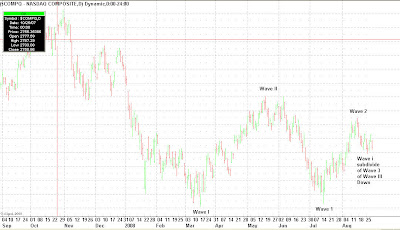
According to my analysis, we are currently entering into a 3rd of a 3rd of a 3rd wave down, which should provide maximum downside acceleration. Below is the Intermediate and Short Term picture.
Intermediate

Conclusion:
The Elliott Wave conclusion is that we are entering a period of extreme risk to both the stock market and the economy. I am using the Nasdaq Composite index for my analysis.
For those who are uninitiated in Elliot Wave analysis. The concept is essentially one of Waves of buying and selling that subdivide into varying degrees.
According to my analysis, we are currently entering into a 3rd of a 3rd of a 3rd wave down, which should provide maximum downside acceleration. Below is the Intermediate and Short Term picture.
Intermediate
Short Term - 5 Minute Bar Chart
Implications For Interest Rates: (All speculation) The implications for the Interest Rate market is actually quite complex. What I see happeneing is a short term implosion of the mortgage markets. In my opinion there is virtually no question that Freddie Mac is a "dead man walking", and that Fannie Mae is not much better off. However, the government will be forced to save one of the two, and they will save Fannie Mae.
In the whole scheme of things, neither Fanne nor Freddie's portfolio quality is all that bad. Not perfect, but not that bad. Their default rates are not terribly bad, considering where we are in the housing market cycle, although if you look at the default rates of loans originated from say 2005 through the summer of 2007, then yes, those loans definitely took on a substantial amount of needless risk. But despite that, at the core of the problems of both Freddie and Fannie, is not loan quality, per se. It is the loan quality GIVEN the amount of leverage they took on. They have taken on an amount of leverage that allows for virtually zero error toleranve regarding default/foreclosure rates. There is no margin for error built into their current system. Both Freddie and Fannie have constructed a portfolio risk profile that is sadly, very similiar to the model used by Long Term Capital Management, in my opinion. In order to chase return, both Fannie and Freddie have over-leveraged their loan portfolios at a time in the economic cycle that they should have been gradually de-leveraging. Simply put, both firms have been grossly mis-managed.
With all this as a background, in my opinion, the mortgage markets are about to enter THE period which the government has tried so hard to avoid...The Great Flush. We are about to see the mortgage markets seize up. We are going to see them seize up because the markets need to unravel this mess.
For example: Banks hold a great deal of Fannie Mae preferred stock in their portfolios, stock that is used to count towards their capital requirements with the Federal Reserve. As the value of this preferred stock gets written down, banks have less capital, thus less money to lend. I use this as an example, but it is truly the tip of the iceberg that we are headed towards.
There is the unwinding of CDOs that will take place. And this is a much more complicated process.
John Maudlin explains it quite well in his email newsletter of August 22, 2008:
Fannie, Freddie, and the Credit Crisis
Let's turn to Freddie and Fannie. There must be some people who think there is some way that the shareholders of Fannie and Freddie will not lose everything, as their shares actually trade. This just simply goes to show that you can fool some of the people some of the time. And as we will see, some of those people are very serious institutions.
It is almost a forgone conclusion that the US Treasury will have to step in and for all intents and purposes nationalize the two government-sponsored enterprises. The estimated losses in these two firms are far beyond what they could raise in a traditional market. And the longer the government waits, the worse the situation is likely to get.
Moody's downgraded the preferred stock in these firms to almost junk level because of the increased likelihood of "direct support" from the US Treasury, which, depending on the nature of the support, could wipe out both the holders of the common and the preferred. The preferred shares have already lost half their value since June 30 on speculation that an intervention would mean a stop in dividend payments (highly likely) and issuance of new preferred that would take preference over current preferred.
Interestingly, this would put more pressure on the banking system, as many banks hold the GSE preferred shares as assets, choosing to get a little extra return over traditional and more conservative assets. But then of course, Fannie and Freddie preferred were considered safe just a few months ago, with the best ratings from Moody's.
"Regional banks including Midwest Bank Holdings Inc., Sovereign Bancorp and Frontier Financial Corp., may have the most to lose. Melrose Park, Illinois-based Midwest has $67.5 million, or as much as 23 percent of its risk-weighted assets, in the preferred stock, while Philadelphia-based Sovereign owns about $623 million and Everett, Washington-based Frontier about $5 million." (Bloomberg)
It is doubtful that banks which hold these assets have written them down yet, but with a downgrade they will almost certainly be forced to do so in the near future. For the record, Fannie Mae has 17 classes of preferred stock, with more than 600 million shares outstanding. Freddie Mac has 24 classes of preferred stock, with about 460 million shares outstanding. The existing shares are trading worse than junk bonds, paying 17-19%.
And it may be a total write-off. It is hard to imagine how Treasury Secretary Paulson, or a new Treasury Secretary next year, could put US taxpayer money into the companies at risk without wiping out the current common and preferred shareholders. The justified outrage would be huge.
The basic problem is that without Freddie and Fannie the US mortgage market would go from crippled to moribund, if not dead. We have created a system that could not function in the short term without them, and the pain of allowing them to collapse would be another 1930s-style Depression, the era in which these firms were first created. They were never designed to take on the huge leverage they did, or to use hundreds of millions in lobbyist money and campaign contributions to create a massive payment scheme for management and shareholders. Congressional estimates are that this could cost US taxpayers $25 billion, a significant multiple of their current market caps.
Fannie and Freddie will not be able to raise capital on their own. At this point, why would any rational investor put that much money into a company with such a convoluted preferred share scheme, without government guarantees? That estimated loss assumes that the housing market does not get worse from this point. Losses could be much worse, or things could get better. Who knows? Why invest in something with so much uncertainty?
But there are more problems. You can't just take someone else's property, and that is what stock is, without some serious reasons. You almost are forced to wait for a crisis, otherwise shareholders would sue, saying that they suffered unnecessary losses. You can certainly expect the preferred shareholders to sue. That is why Paulson hired JP Morgan to figure out how to recapitalize the banks. I don't envy the people who are working on that one. Maybe there is some magic somewhere, but as we saw with Bear Stearns, at the end of the day it is all about adequate capital.
The GSE companies should be adequately capitalized and broken up into much smaller firms that would not be too big too fail in the future, and put under a regulator that would enforce reasonable leverage limits, with the profits going to pay back the US taxpayer before any profits or dividends are paid to any other future owners.
That is, if the government takes the two GSEs and puts capital (probably in the form of loans and guarantees) into them, which puts taxpayers at risk, then allows a public offering of the smaller entities to raise capital to repay the loans, any shortfall should be made up by the issuance of preferred shares, and the common shareowners would wait until the government loan was repaid before they would be eligible for a dividend.
And the people responsible for creating the leveraged systems, the board, et al., should be forced to resign. New top management all around.
The ultimate goal should be for taxpayers to get their money back and any guarantee, implicit or explicit, to be removed. No mortgage bank should ever again be allowed to be too big too fail.
Now, taken as a part of the total credit crisis, which will run to over $1 trillion (at least), $25 billion may not seem like a lot. But I hope this is a wake-up call for better regulations and safeguards.
And before I go, let me reiterate my call for regulators to force banks to move their credit default swaps to an exchange. The potential for a blow-up is serious, and it could dwarf the current credit crisis. I am not saying it will happen, just that it could. Even a low-risk event should be protected against. Credit default swaps are legitimate business transactions. They are very useful. They should just be put on an exchange, like futures or options, where there is 100% transparency as to counterparty risk.
Wednesday, August 20, 2008
Fannie Freddie Looking Ugly - Real Ugly
Not to be an alarmist, but the stocks charts of both Fannie Mae (FNM) and Freddie Mac (FRE) look to be in what I call a "death spiral", which is a stock march to either extinction or a long time-out under $5. We've seen it with other bank stocks, Indymac, National City, WAMU. In indymac's case, they went out of business. For WAMU and National City, amongst others, they're hanging on for dear life.


Now, I call it a "death spiral", but it doesn't necessarily mean that the company goes out of business; it could mean that the company bumps along the bottom for a protracted period of time recapitalizing itself. Either way, it's ugly, and either way, we need to begin to visualize the mortgage world with either a greatly reconfigured Fannie Mae and Freddie Mac, or without either of those two companies.
The key to Fannie and Freddie's survival is how long it takes for the default/foreclosure rates to bottom. Once the market gets some clarity regarding that issue, then you'll begin to see capital begin to move back into the mortgage markets.
The ARM resets peaked this summer, and they will essentially fall off the table after December 2008. From January 2009 moving forward, the credit markets should begin to see the shape of the mortgage default/foreclosure situation, in essence how deep the water is. The question for Fannie and Freddie is whether they can survive to that point recognition in the credit markets.
My guess is that in the end, Freddie Mac folds it's tent, and Fannie gets saved, but shareholder equity gets massively diluted.
Friday, August 15, 2008
Banks Already Bankrupt?
Are the banks already bankrupt? That is the money-shot in an interview with Marc Faber:
http://www.creditwritedowns.com/2008/06/marc-faber-says-avoid-financials-and.html
Q: On the financial sector, part of the reason why we saw the sell-down in the US overnight was because of a downgrade for some of the brokers there. There are still lingering concerns about the impact on the financials, not just in the US but Europe as well. You expect about 150 bank failures in the next 12 months. Can you explain this?
A: A lot of banks are already bankrupt. A lot of monoline insurance companies are bankrupt and financial institutions hide their rotten assets in level three asset categories where you don’t really need to value them. But, if you have stock prices like the monoline insurance Ambac and MBIA dropped 95% and then some rating agencies until last week were still carrying a AAA rating. It is a total joke.These companies are basically out of business. So, the financial sector by and large has much larger problems than is perceived by the investment community. The stock market to some extent is telling you that. It is giving you the price, market signals. It is quite funny that one financial firm downgrades another financial firm and another financial firm begins to downgrade a financial firm that was downgrading themselves. It is kind of a domino effect. It is actually quite amusing to watch it all.
This leads to a discussion of what are called Level 3 Assets.
Here's a good discussion of Level 3 Assets:
http://www.themoneyblogs.com/urbandigs/my.blog/level-3-assets-credits-next-concern.html
Level 3 Assets: Credit's Next Concern
Posted on 11/04/2007 06:26:00
A: I want to discuss what will soon be in the media alot, as round 2 of the credit crunch already is underway! First off, I don't care what CEO's get fired or how many rate cuts printing press Ben Bernanke does, the credit crisis problems lie so deep that these actions will not cure the disease; it will only provide some temporary relief as the problem phases itself out. What we need to look out for now, is what round 3 of the credit crunch may be caused by. I think it will be lowered valuations for Level 3 Assets. On November 15th, a new accounting rule will require the disclosure of these assets whose market valuations were assigned by in-house models, as the market where they trade in are illiquid and in distress.
LEVEL 3 ASSETS (via Marketwatch.com) -
Level 3 assets are those that trade so infrequently that there is virtually no reliable market price for them, and valuations for these assets are based on management assumptions.
Problems people! I've discussed many times in the past few months how the markets for these CDO's, CMO's, and other mortgage backed securities have seized up. There are just no bids and no volume, making no market!
Now, what we do know is that brokerages, banks, hedge funds, and other institutions are holding very complicated assets whose actual value has virtually vanished. The key word here is actual, or real market value. But these level 3 assets are NOT being marketed to the real market! They are being held, hidden on the books of major corporations and institutions, as management places their best-guess valuations that are almost always grossly overvalued!
Round 3 of the credit crunch will be the 'coming out' of sorts of the adjusted valuations of these level 3 assets leading to the uncovering of major losses to the most exposed corporations and institutions. I think this process will take months to play out and we are heading right into the heart of storm as November 15th approaches.
______________________________________
Ok, so now we've got an idea of what Level 3 Assets are (the toxic mortgage paper that nobody wants), now let's see who's holding the most of this stuff.

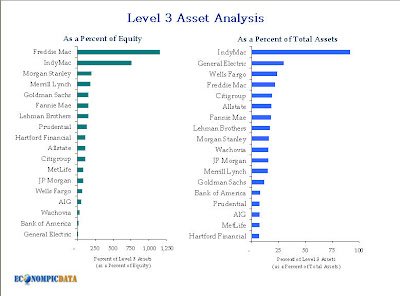 As a percentage of equity, Freddie Mac holds the top spot. Not good.
If you're wondering why Indymac went out of business, take a look at the top of the two charts above. If you're wondering why it's going to take a government bailoout to prevent Freddie Mac from going out of business, take a look at the two charts above.
http://www.creditwritedowns.com/2008/06/marc-faber-says-avoid-financials-and.html
Q: On the financial sector, part of the reason why we saw the sell-down in the US overnight was because of a downgrade for some of the brokers there. There are still lingering concerns about the impact on the financials, not just in the US but Europe as well. You expect about 150 bank failures in the next 12 months. Can you explain this?
A: A lot of banks are already bankrupt. A lot of monoline insurance companies are bankrupt and financial institutions hide their rotten assets in level three asset categories where you don’t really need to value them. But, if you have stock prices like the monoline insurance Ambac and MBIA dropped 95% and then some rating agencies until last week were still carrying a AAA rating. It is a total joke.These companies are basically out of business. So, the financial sector by and large has much larger problems than is perceived by the investment community. The stock market to some extent is telling you that. It is giving you the price, market signals. It is quite funny that one financial firm downgrades another financial firm and another financial firm begins to downgrade a financial firm that was downgrading themselves. It is kind of a domino effect. It is actually quite amusing to watch it all.
This leads to a discussion of what are called Level 3 Assets.
Here's a good discussion of Level 3 Assets:
http://www.themoneyblogs.com/urbandigs/my.blog/level-3-assets-credits-next-concern.html
Level 3 Assets: Credit's Next Concern
Posted on 11/04/2007 06:26:00
A: I want to discuss what will soon be in the media alot, as round 2 of the credit crunch already is underway! First off, I don't care what CEO's get fired or how many rate cuts printing press Ben Bernanke does, the credit crisis problems lie so deep that these actions will not cure the disease; it will only provide some temporary relief as the problem phases itself out. What we need to look out for now, is what round 3 of the credit crunch may be caused by. I think it will be lowered valuations for Level 3 Assets. On November 15th, a new accounting rule will require the disclosure of these assets whose market valuations were assigned by in-house models, as the market where they trade in are illiquid and in distress.
LEVEL 3 ASSETS (via Marketwatch.com) -
Level 3 assets are those that trade so infrequently that there is virtually no reliable market price for them, and valuations for these assets are based on management assumptions.
Problems people! I've discussed many times in the past few months how the markets for these CDO's, CMO's, and other mortgage backed securities have seized up. There are just no bids and no volume, making no market!
Now, what we do know is that brokerages, banks, hedge funds, and other institutions are holding very complicated assets whose actual value has virtually vanished. The key word here is actual, or real market value. But these level 3 assets are NOT being marketed to the real market! They are being held, hidden on the books of major corporations and institutions, as management places their best-guess valuations that are almost always grossly overvalued!
Round 3 of the credit crunch will be the 'coming out' of sorts of the adjusted valuations of these level 3 assets leading to the uncovering of major losses to the most exposed corporations and institutions. I think this process will take months to play out and we are heading right into the heart of storm as November 15th approaches.
______________________________________
Ok, so now we've got an idea of what Level 3 Assets are (the toxic mortgage paper that nobody wants), now let's see who's holding the most of this stuff.

 As a percentage of equity, Freddie Mac holds the top spot. Not good.
If you're wondering why Indymac went out of business, take a look at the top of the two charts above. If you're wondering why it's going to take a government bailoout to prevent Freddie Mac from going out of business, take a look at the two charts above.
Wednesday, August 6, 2008
Recent Gyrations
Stock Market - Nasdaq


Home Prices Could Plunge Another 20%: Freddie CEO

It's time for me to fess up. When I was much younger, I used to do a great deal of stock trading. I was very much into technical analysis and cut my teeth on Elliot Wave Theory. I saw Bob Prechter on Wall Street Week, as he had nailed gold prices back in the early 80's, and I was hooked. The truth is, as I've matured, I've veered away from Elliot Wave as a primary tool for analyzing markets. Imo, EWT is too limited, and frankly there are always multiple interpretations. Again, imo, the practioners of EWT are always perfect in hindsight, but there have been too many major miscalls along the way (Dow 3686 as THE major market top, for example) for me to look at EWT as a primary analysis tool. It simply hasn't been reliable enough, and frankly, it's too simplistic.
Having said all that, I suppose due to my early training, when I look at a stock chart, especially an index chart, I see it through the eyes of Elliot. 5 Wave as a basic impulse, 3 Waves as a counter-trend wave.
I mention this because as I look at the Nasdaq chart, it seems to be pretty clear.

From October 30, 2007 to March 17,2008 the Nasdaq was in an initial primary leg down.
10/30/07 High: 2828.32
03/17/08 Low: 2,155.42
Total decline: 673.4 point or 23.81% decline from the high, 31.24% decline measuring the 3/17 low as the denominator.
Counter-trend rally targets:
Math for calculating targets:
I'll create one example for the 61.8% target, you have to walk through the rest of the math on your own, or trust my numbers.
673.4 (Nasdaq Point Decline) / 2155.42 (Nasdaq Low) = 31.24%
31.24% * 61.8% = 19.30766% * 2155.42 = 416.16 points (Counter-trend Point Target)
2155.42 Wave 1 Low + 416.16 (Counter-trend Point Target) = 2571.58 Target
61.8%: 2571.58
50%: 2492.10
38.2%: 2412.64
The counter-trend rally appears to have ended on 06/05/08 at 2549.99. Based on the wave structure, and that we came very close to hitting the 61.8% Counter-Trend price targets, I've concluded that a Wave 2 counter-trend rally ended on 06/05/2008. The significance of this is that Elliot Theory states that Wave 3, which we have entered into if I am correct, is typically the most brutal, violent leg down.
Subdividing Wave 3:
Wave i :
06/05/08: 2549.92 High
07/15/08: 2167.29 Low
Points: 382.63
Short Term Chart:
Wave ii: (we are currently in counter-trend wave ii up)

So we are in what is called a complex wave ii, what's called a triple correction. The key point is that it appears that the market is very close to the end of this correction, so we should know very soon, whether I've got the big picture correct. And the big picture is for another major market decline, with the lows of March 17 at 2155.42 on the Nasdaq to be significantly broken.
Technicals Meshing With Fundamentals
I mention all this because there have been a number of stories about Freddie Mac today, it's potential insolvency, and speculation about how much more pain we have in the housing market. It's a situation where the fundamentals in the economy fit with the technical picture painted by the Elliot Wave analysis. Consistent with this theme, is the story from Morgan Stanley, freezing Helocs.
Morgan Stanley Said to Freeze Home-Equity Credit Withdrawals
Home Prices Could Plunge Another 20%: Freddie CEO
Banks Lead Decline After Freddie Results
Freddie Mac
FREDDIE MAC
FRE
7.14 -0.90 -11.19%
lost $1.63 a share, about three times as big as the loss of 53 cents a share analysts had predicted. The company said it's doubling its provisions for loan losses to $2.5 billion since the end of the first quarter and that it will slash its dividend by as much as 80 percent.
FREDDIE MAC
FRE
7.14 -0.90 -11.19%
lost $1.63 a share, about three times as big as the loss of 53 cents a share analysts had predicted. The company said it's doubling its provisions for loan losses to $2.5 billion since the end of the first quarter and that it will slash its dividend by as much as 80 percent.
Subscribe to:
Posts (Atom)

