Sunday, December 18, 2011

Cost of Tax Cut: Another $17 a Month on Most Mortgages

http://www.cnbc.com/id/45708514

Who is paying for the two-month extension of the payroll tax cut working its way through Congress? The cost is being dropped in the laps of most people who buy homes or refinance beginning next year.

The typical person who buys a home or refinances starting on Jan. 1 would have to pay roughly $17 more a month for their mortgage, thanks to a fee increase included in the payroll tax cut bill that the Senate passed Saturday. The White House said the fee increases would be phased in gradually.

The legislation provides a two-month extension of a payroll tax cut and long-term unemployment benefits that would otherwise expire on Jan. 1. It would also delay for two months a cut in Medicare reimbursements for doctors that is scheduled to take effect on New Year's Day. The House is expected to act on the bill early next week. Two more months of the Social Security tax cut amounts to a savings of about $165 for a worker making $50,000 a year.

To cover its $33 billion price tag, the measure increases the fee that the government-backed mortgage giants, Fannie Mae and Freddie Mac, charge to insure home mortgages. That fee, which Senate aides said currently averages around 0.3 percentage point, would rise by 0.1 percentage point under the bill.

For the holder of a typical $200,000 mortgage, that means their monthly housing payment would be about $17 higher.

The 0.1 percentage point increase will also apply to people whose mortgages are backed by the Federal Housing Administration, which typically serves lower-income and first-time buyers.

The higher fee would not apply to people who currently have mortgages unless they refinance beginning next year.

Because of the weak housing market and the huge numbers of foreclosures in the last few years, private insurers have not competed strongly for business with Fannie Mae and Freddie Mac, which have the backing of the federal government. As a result, about 9 in 10 new home mortgages are backed by Fannie Mae, Freddie Mac and the FHA.

President Obama and many congressional Democrats and Republicans want to curb Fannie Mae's and Freddie Mac's dominance in the mortgage market. Obama earlier this year proposed raising the mortgage guarantee fees they charge as one way to do that.

Posted via email from htlkirkland's posterous

Thursday, December 8, 2011

Important Moments: Living History of Interest Rates, A Guaranteed Longshot

Interest Rates are declining today: a "perfect storm" for those looking to refinance, with the window of opportunity opening today. As I write this email, the interest rate on the 10 Year Treasury note is at 1.98%. While 30 year fixed mortgage rates don't move in 100% lockstep with 10 Year Treasuries, the correlation is extremely high; think of a tether linking the 30 Year Fixed Mortgage rate and the 10 Year Treasury Note.

I am writing this email while watching Jon Corzine testify in front of Congress. It's a very sad day for the former CEO of Goldman Sachs and the recent CEO of MF Global to say under oath that he doesn't know where the money went.

But this email is not about Jon Corzine's testimony, per se. It is about a "Perfect Storm" that appears to be unfolding that may, potentially, lead to slightly lower interest rates in the immediate near future.

The "Perfect Storm" is 1) the combination of the failure of the EU to come to a meaningful agreement, essentially buying more time because fundamentally the countries are having immense difficulty coming to an agreement to resolve their issues, and 2) a lack of liquidity in the financial futures markets that has resulted from the MF Global fiasco. Up until now, this lack of liquidity, since the October 31, 2011 bankruptcy of MF Global hasn't had a catastrophic impact on the financial markets. But with the potential severity of the EU situation combined with the reduced liquidity in the financial markets from the MF Global fiasco, we may be facing somewhat temporary, but very upsetting "Risk Off" trade, meaning money would be temporarily flowing on a major scale into US Treasuries, perceived to be a safe haven. With interest rates under 2% on the 10 Year Treasury, it seems that process has begun. The question is: will it continue, and if so, how far?

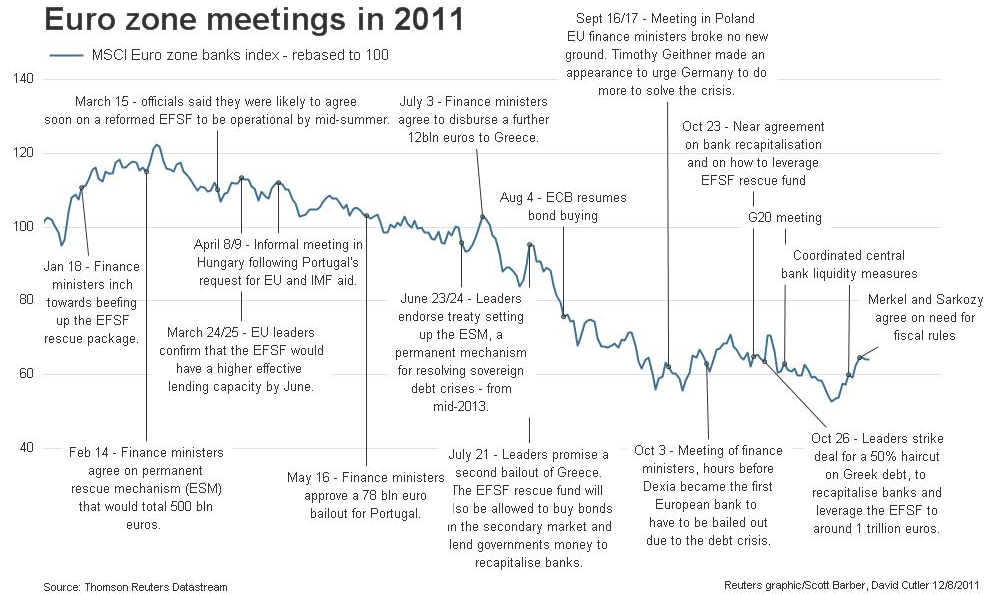
History of EU Summits

Hat Tip to Barry Ritholtz' The Big Picture Blog link

(click on link to see chart)

As we can see above, we've had many Euro Zone meetings in 2011 to address the European debt crisis. And the net effect of these meeting has been disappointment, and it appears that today's summit is going to be disappointing as well.

Now, as I write this email, we don't know the final announcement from European leaders. That will come out in the wash tomorrow. Maybe there will be a pleasant surprise for the markets to cheer.

If we get a "pleasant surprise" from the markets, the short term effect will be a relief rally in "Risk On" assets and a selloff in "Risk Off" assets. To simplify matters, "Risk On" assets are assets like stocks and commodities. "Risk Off" assets are U.S. Treasury Bonds and mortgage backed securities. In short, "Good News" means higher interest rates, "Bad news" means lower interest rates.

So if we get "bad news", implying lower interest rates, the big question is "how much lower can interest rates go?". The answer is, historically, not that much lower, but enough to make a difference in your refinance rate. It's critical that if you are looking to refinance right now, that you have someone watch the interest rate market like a hawk, with a finger on the lock trigger.

The History Of Interest Rates - A Guaranteed Longshot
Below is the graph, from the Federal Reserve Bank of St. Louis link, of the daily closing yield of the US 10 Year Treasury from January 1, 1962 to December 6, 2011.

As I write this email, the U.S. Treasury 10 Year yield is at 1.98%. To put this yield into historical context, I have downloaded all of the days in the above chart, a total of 13,026 days, from January 1, 1962 to December 6, 2011. Out of these 13,026 days, there has been a grand total of 19 days, all of them in 2011, with interest rates below 2%. Most people would look at a 19 out of 13,026 chance as being an incredible long shot, a long shot not even worth considering or thinking about because, well, let's face it a 19 out of 13,026 long probably is not going to happen. But in this case, today, if you are looking to refinance,  we have a guaranteed opportunity to lock in a 19 out of 13,026 long shot. It's literally here today.

Now putting together the historical opportunity presented above, there is also the practical matter of refinancing. If you do not have a loan application in the system, you need to begin the process. It only takes a few minutes of time on the phone. Once we get an automated approval, we can get the lock process started.

Can interest rates go lower?

I'm going to surprise some folks when I say this, but if the official EU announcement is perceived by the markets as disappointing, then the answer to this question in yes, it is possible that we may see interest rates going slightly lower than where they are at right now. But we also know that interest rates simply don't stay below 2% for very long. Some sort of crisis pushes the rates below 2% for a few days (think of a beach ball pushed below the water and then popping back up quickly) , and then the economic pressures causing the rates to go below 2% ease up, and rates pop back up. Historically, the lowest interest rate on the 10 Year Treasury in the Fed's database, from 1962 to today, was on September 22, 2011 at a rate of 1.72%. Here are all the interest rates below 2%, from 1962 to today.


Date

 Interest Rate

2011-09-22

2011-10-03

2011-10-04

2011-09-23

2011-09-21

2011-11-23

2011-09-26

2011-09-30

2011-10-05

2011-09-09

2011-09-12

2011-11-22

2011-09-20

2011-11-17

2011-09-19

2011-11-21

2011-11-25

2011-11-28

2011-09-06

2011-09-29


1.72

1.80

1.81

1.84

1.88

1.89

1.91

1.92

1.92

1.93

1.94

1.94

1.95

1.96

1.97

1.97

1.97

1.97

1.98

1.99


If you are considering refinancing your mortgage, I would say that this rare window of opportunity is now open. "Guaranteed" longshots rarely come along in life, and when they do, one needs to be prepared to take advantage of the opportunity that presents itself.

Note:this is the text version of an email sent to clients. I'm posting this via posterous, which does not allow me to include the graphs. For those that want the original email, I can be contacted at dan.mellis@htlkirkland.com


Posted via email from htlkirkland's posterous

Wednesday, October 26, 2011

Ask Captain Scott

Incredibly cool website: Ask Captain Scott http://askcaptainscott.com/

Scott is a commercial airline pilot and the website takes you into the cockpit of real planes.


Posted via email from htlkirkland's posterous

Wednesday, August 3, 2011

Interest Rates:10 Year Treasuries Plunging

Interest rate are dropping big time the last three days.


There are three obvious reasons:


1) Very weak GDP report last Friday, with an especially weak revision. For Q2-2011, GDP grew at an annual rate of 1.3%, and Q1-2011 GDP was revised down to 0.4% GDP growth. Link


2) A weaker ISM Manufacturing report on Monday. "The PMI registered a 50.9%, a decrease of 4.4 percentage points..." link ; followed by a tepid ISM non-manufacturing report today, link


3) Italy taking center stage in the ECB/EU slow motion trainwreck, with Prime Minister Berlusconi poised to put gasoline on the fire later today in a nationwide speech. link


There is a major forth item that is looming in the background: some form of QE3. If history is any guide and we see additional Quantitative Easing, we will see interest rates move higher.


The interest rate conditions right now look very attractive to lock in interest rates at these levels.


Current Interest Rates